“I am only one, but still I am one.
I cannot do everything, but still I can do something.
And because I cannot do everything,
I will not refuse to do the something I can do.”

Edward Everett Hale

Showing posts with label Quakers. Show all posts

Saturday, 4 May 2019

The power of dreams

This week's quotation is by Transcendentalist Henry David Thoreau, above a beautiful photo of Neuschwanstein Castle. It reads "Wenn wir von unseren Träumen leiten lassen, wird der Erfolg all unsere Erwartungen übertreffen."

Which being translated, means: "If we let our dreams guide us, success will surpass all our expectations."
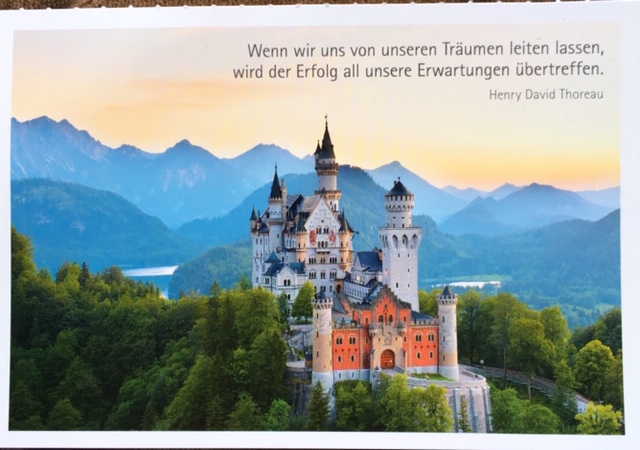

I have a dream.

At the 2015 General Assembly meetings, all ldelegates were given a 48-page document entitled Vision for Our Future produced by the Executive Committee, which also went out to all congregations. It was followed by another, entitled The Next Steps.

In the Vision for Our Future document, there were a series of headings, the first of which read, "We want to be a faith that matters." Well, our faith does matter - it matters enormously, both to current Unitarians, and to potential Unitarians, who are out there, desperately seeking somewhere they can call home, somewhere they can find like-hearted (not necessarily like-minded) folk to accompany them on their own spiritual / religious journeys.

BUT, unless those seekers (and current Unitarians) clearly understand who we are and what we're about, we aren't going to attract new people through our doors.

We Unitarians have always been so hot and strong about being the "faith without a creed" and about the pre-eminence of freedom of belief. And that is right and good. BUT I'm afraid it is now becoming a disadvantage in some ways, as only too often we find it difficult to articulate our faith, except in negative terms. For example, there was a photo of a particular congregation's noticeboard on Facebook a while back - five sheets of paper with statements that started "We don't".

We need to find easy-to-articulate, POSITIVE answers to "What do Unitarians believe?" and "What are Unitarians?" Which is why I carried out my survey in 2017, which resulted in the book Unitarians: Together in Diversity. Which is chock-full of positive statements about what Unitarians believe, and how we come together in community.

But I have come to believe that the statement the Executive Committee made in Vision for Our Future, about needing to "re-establish an identity, a unique spiritual position" is key to our future as a denomination, as a movement. As James Barry so acutely pointed out in his contribution, "We don't have the advantage of the UUA, who have their seven principles defined."

I believe that the most vital task for British Unitarians today is to adopt a widely agreed statement such as the UUA's Seven Principles (or why not just adopt them wholesale? - they work for me!). I believe that one of the main reasons why the Quakers are so much more successful than we are, is that other people understand what they believe in and stand for.

We could even produce our own versions of Advices and Queries, the Quaker touchstones, and of Quaker Faith and Practice, their comprehensive book about Quaker beliefs and practices. Why not?


Saturday, 31 August 2013

Honesty - always the best policy?

I have been brought up to believe that honesty is the best policy. It was drummed into me as a child that one should always tell the truth, and that telling lies or acting dishonestly was wrong. The Quaker Advice no. 37 asks:

"Are you honest and truthful in all you say and do? Do you maintain strict integrity in business transactions and in your dealings with individuals and organisations? Do you use money and information entrusted to you with discretion and responsibility?"


And Alfred Hall, in Beliefs of a Unitarian, writes: "Unitarianism is not a system of creeds or beliefs. It is more than anything else an attitude of mind. It is a fresh way of looking at life and religion. ... Its method is that of appeal to reason, conscience and experience generally, and above all to elemental principles of truth and right which are implanted in the human heart at its nobles and embedded in the universe."

So not much room for equivocation then.

I wonder. Perhaps being honest and truthful is generally the best policy, but sometimes, just sometimes, telling a white lie, or even a whopping, great black lie may be the right thing to do. To cite just one example, look at the Dutch, German and other citizens during the Second World War, who hid and protected Jews, and saved their lives, by lying to and deceiving the Nazis.

And I honestly (there's that word again) do believe that sometimes telling a white lie in order to avoid hurting someone's feelings is definitely the best policy. Perhaps the key to knowing when to bend the truth is to use your reason and conscience, and to put what you believe to be right over the simple yes/no of telling a lie or telling the truth. I can see the dangers of this - if we do this, we are having to judge what is right or wrong in each individual case, and sometimes, we don't have enough information at our disposal to make the best decision (or what turns out to be the best decision in the long run).

I don't have any answers. Perhaps the best that any of us can do is to follow the best that we know, and to hope and pray that we will be guided to do and say what is right. May it be so.

Friday, 15 February 2013

When will there be peace?

Ten years ago today, the largest ever anti-war rally in history took place, as millions of people in sixty countries expressed their opposition to the imminent war with Iraq. In spite of this, the war began on 20th March.

It is now well over fifty years since World War II, but since then, not a single day has passed in which there was not a war going on somewhere in the world - whether it was called a civil war or a "police action".

War is an expensive business, in every sense of the word. If all the money currently spent on defence were to be channelled into education, health and welfare; into feeding the hungry and housing the homeless, what a different world this would be.

If we reject the concept of war altogether, the alternative is pacifism. In the 1930s, an Anglican minister named Canon Dick Sheppard founded the Peace Pledge Union. Tens of thousands of people joined it, pledging never again to wage war. In her autobiography Testament of Experience,  Vera Brittain reports a discussion with her husband, George Catlin, on the issue of pacifism:

Vera Brittain

 Catlin wrote: "I will not stop to inquire whether pacifism as an absolute principle is sound. In measurable time you will not convert to it the majority of this great nation. and therefore (whatever one's private view) it will not, as a public fact, avert war."

Brittain argues that "the same argument applied to all forms of revolutionary teaching, costly and often dangerous to its interpreters, which visualised life in terms of a society still to come. The fallibe Apostles could never have hoped to convert the great Roman Empire to Christ's doctrines "in measurable time". But surely few would now say that the early Christian Church should have abandoned its task as too difficult, even though neither the lands once ruled by Rome nor the rest of humanity were converted even yet?"

She went on to join the Peace Pledge Union, and bore witness for peace for the rest of her life, often at considerable personal cost.

And yet, and yet. I have blogged before about my feelings about pacifism: "To fight or to take a pacifist line is one of the deepest and starkest choices of personal conscience. Is pacifism a cause worth fighting for? What a paradox. I speak as one who has a fairly volatile temperament at times, and one who is not a naturally pacific person. I admire Vera Brittain enormously, and the Quakers too. I am also deeply impressed by the realisation that we are all human beings, given life by God. What right have others to take that life away? What cause can possibly justify it? Not many, I think."

Maybe all that anyone can do is their best, where they are, to promote peace through following the Golden Rule in our lives, and trying to behave towards those we connect with, with loving-kindness, or compassion.


Saturday, 14 April 2012

The challenges for liberal religions

One of the highlights for me of the recent General Assembly of Unitarian & Free Christian Churches Annual Meetings was the keynote speech by Paul Parker, Recording Clerk of the Religious Society of Friends (Quakers) in Britain. He spoke movingly about the future of liberal religions from a Quaker perspective. I would guess that most of those present could identify strongly with the challenges he spoke about:

    Paul Parker (photo by John Fitzgerald)
  • to try to understand what is going on with our membershhip, in terms of age distribution etc
  • being confident about who we are and what we offer and being able to talk about it to others
  • how to answer the question "I'm a Quaker [Unitarian] - ask me why" in language accessible to new people
  • living up to what we say and believe - putting our faith into action
  • how do people know we exist - how to raise visibility
  • making sure that people can find us, and that they feel welcome when they do
  • being vibrant, effective communities
  • recognising the variety of ministries within the Quaker [Unitarian] community - acknowledging what gifts people bring and the service they offer
Like the Unitarians, Quakers are a minority faith in the United Kingdom, but have a wonderful and important message to share with many spiritual seekers who are looking for just such a faith. So dealing with these challenges is vital for our future.

Wednesday, 16 March 2011

Quaker Invitation

On Monday, I conducted a funeral for a Unitarian friend at the Quaker Meeting House in Northampton, because our Unitarian premises aren't big enough for rites of passage. When I booked the room, a couple of weeks ago, I found the beautiful invitation below on the home page of the Northamptonshire Quakers website:

"We hope you find here something that is right for you and what you need right now to help you on your spiritual journey and in your daily life
If you are wondering what God may be,
Looking for a purpose in life
Craving company, or seeking solitude,
Come to our Meeting for Worship!
We shall not ask you to speak or sing,
We shall not ask you what you believe,
We shall simply offer you our friendship,
And a chance to sit quietly and think,
And perhaps somebody will speak,
And perhaps somebody will read,
And perhaps somebody will pray,
And perhaps you will find here
That which you are seeking...
We are not saints,
We are not cranks,
We are not different ...

Except that we believe
That God's light is in us all,
Waiting to be discovered."

Apart from the bit about not being asked to sing, I would love to use this welcome on a Unitarian website. We too offer our friendship to those seeking a purpose in life, and do not require them to believe certain things in order to join us in worship. And I personally definitely believe that there is that of God in everyone "waiting to be discovered", although I know that some Unitarians would not agree with me!  

Wednesday, 2 March 2011

"Advices and Queries"

This little red booklet is the reason why I am a "Quakerly-inclined" Unitarian. Each of its forty-two paragraphs is a challenge, a comfort or a reminder of some fundamental religious or spiritual truth. I first came across it about 15 years ago, and was blown away by it - it really speaks to my condition (to use a Quakerly phrase).

Reading it has made me realise that Unitarians and Quakers have an awful lot in common, both theologically and spiritually. Take the introduction: "Within the community there is a diversity of gifts. We are all therefore asked to consider how far the advices and queries affect us personally and where our own service lies. There will also be diversity of experience, of belief and of language. Friends maintain that expressions of faith must be related to personal experience. Some find traditional Christian language full of meaning, some do not. Our understanding of our own religious tradition may sometimes be enhanced by insights of other faiths."

You could build an entire service around each paragraph ... over the years, I probably will.