“I am only one, but still I am one.
I cannot do everything, but still I can do something.
And because I cannot do everything,
I will not refuse to do the something I can do.”

Edward Everett Hale

Showing posts with label passion. Show all posts

Friday, 9 August 2024

Tempering Our Passions

The other day, I was talking with a friend, and she mentioned that she was planning to begin a doctorate in a couple of years' time, about the life of a little known person whom she'd become fascinated by. While she was speaking about it, her whole body became animated: her eyes lit up, her voice grew warmer, and it was easy to tell how passionate she felt about sharing this man's story with the wider world.

And I noticed my own reaction: I was delighted that she'd found something she felt so strongly about, yet relieved that it wouldn't be my job to put in all those years of effort. Which surprised me. A few years ago, my reaction would have been quite different. I would have been thinking, "Oh, wow! I wanna do a doctorate too!" Instead of, "Meh. Sounds like too much hard work to me." This passion was hers, not mine.

My dictionary defines passion as "a very strong feeling", whether it is an emotion, e.g. love, hate, anger, enthusiasm; or of liking something e.g. a hobby or activity; or of sexual love; of a "state of being very angry". Whichever definition you go with, passion is a Very Strong Feeling. 

On the positive side, our passions can motivate us, enthuse us, keep a bright flame of desire burning in our hearts and minds, as we labour to achieve a particular goal. Which is marvellous, if that goal is a positive one, like my friend's, to share an important true story with the world. In which case, we can safely give our passions free rein and follow where they lead.

The danger can come when the passion is ignited by words of hatred, words of fear. When we are swept up by another's originating emotions and find ourselves acting irrationally, hatefully, harming others, inflamed by falsehoods and lies. Or when we find ourselves losing our temper or being impatient with someone else, because they hav annoyed us or don't agree with us or dare to oppose us.

As has been happening only too frequently in the past week or so, when the Far Right has inflamed people's passions, inciting riots and acts of vandalism and violence. 

So we need to learn to temper our passions. "Temper" in this context means to "act as a neutralizing or counterbalancing force to something. e.g. 'their idealism is tempered with realism'" In much the same way as a blacksmith tempers steel by reheating and then cooling it. 
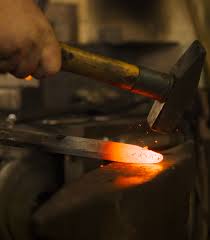

(image: PxHere)

We need to apply the cold water of reason and fact checking to our passions, rather than letting another's words or images inflame them.

You may have noticed that most of the descriptive phrases in this post have been elemental - to do with the fire of passion, or its tempering in cold water. Which reminded me of the words of John Greenleaf Whittier, a Quaker hymn writer:

"Drop thy still dews of quietness,
till all our strivings cease:
take from our souls the strain and stress,
and let our ordered lives confess,
the beauty of thy peace."

Amen


Friday, 26 April 2024

Living with Passion

The 16th century philosopher, René Descartes, once wrote, "Trying to live without philosophising is like keeping your eyes closed without thinking about opening them."


And, while I don't quite agree with him, what I do agree with is the spirit behind the words. I think that what he is saying, is that in order to live a full and satisfying life, it is necessary to be passionate about something. In his case, it was philosophy.

Which made me wonder what I need so strongly that I am passionate about it. And I came up with four answers: the love of my family and close friends; walking in nature (particularly Salcey Forest, or by lakes, mountains and the sea); reading books; and being creative, whether that is in the form of writing, or crochet, or cross-stitch. When I am engaged in or with any of those activities, I am blissfully happy. I can spend inordinate amounts of time doing them, and never get bored or fed up. Time passes by in a flash and I don't want whatever it is to come to an end.

Which has occasionally got me into trouble... whenever a new book by a favourite author comes out, I am avid to read it, and actively resent any time spent away from it until that first blissful reading is done. Then I go back for a more leisurely second reading, which can be interrupted.

Which doesn't mean to say that I neglect the other parts of my life. My Protestant work ethic is too strong for that. Rather, it means that I get them done and dusted as quickly as possible, so that I can return to my passions. Today, for example, I estimate that I have a couple of hours of work to do, after which I plan to settle down with the baby blanket I'm crocheting for my daughter's yet-to-be-born son, and will probably spend most of the rest of the day on it, stopping only for meals. During which time, I will be as happy as a pig in clover.

What are you passionate about?

Friday, 1 July 2022

Passion + Discipline = Bliss

 I found this week's quotation, from Yehudi Menuhin, one of the greatest violinists of the last century, fascinating. as it could be read in two different ways. It says, "Bliss is above all moderation."


And I realised that this could be taken in two ways:
        1 [Bliss is above] [all moderation]
        2 [Bliss is] [above all] [moderation].

Which mean very different things. Did he mean that bliss is the most important thing and that it trumps moderation in every case? Or did he mean that bliss is all about moderation? And what does moderation mean, anyway? I checked the word on the wonderful website Power Thesaurus, and was presented with alternatives which included "restraint", "control" and "prudence". 

So I googled 'Yehudi Menuhin quotes' to see what else he had written, and found that he seems to be advocating both bliss and moderation. In one quote, he wrote, "Music creates order out of chaos: for rhythm imposes unanimity upon the divergent, melody imposes continuity upon the disjointed, and harmony imposes compatibility upon the incongruous." Which seems to suggest that he values the disciplinary aspects of music - how it enables unanimity, continuity and compatibility - balance. He also asked, "Do we not find freedom along the guiding lines of discpline?"

He was clear that if he wanted to play well, he would need to work hard. He wrote, "To be an outstanding musician, you have to be very attentive to the smallest detail, and willing to have infinite patience in the pursuit of your ideal. You require absolute control and professionalism."
 
On the other hand, he also wrote, "Improvisation is the expression of the accumulated yearnings, dreams, and wisdom of the soul." And said that "the violinist is that peculiarly human phenomenon distilled to a rare potency - half-tiger, half-poet." He saw music as "a path between ourselves and the infinite."

So I come to the conclusion that Menuhin believed that it is necessary to combine your passion for your craft (whatever that is) with the discipline to practice it regularly, so that you will be able to achieve greeat things. It is when you combine the passion and the discipline that the bliss results.

I recognise the truth of this from my own discipline as a writer. I love writing and know that if I want to become the best writer I can be, I need to sit down every day and write something. And that when I do, the result will sometimes be blissful. And that is worth all the times of frustration and struggle which are a concomitant part of the writer's life.


Friday, 27 May 2022

Passion and Devotion

 I have found a very interesting person, with this week's quotation: Paula Modersohn-Becker. She was a late 19th / early 20th century German Expressionist artist, who died at the tragically young age of 31, days after giving birth to her first child. She wrote, "You simply have to devote your whole self to the one, original" (or perhaps, most important) "matter. This is the way something can and will become" (or perhaps, come into being).


She was a devoted artist, and has left copious letters and journals which share her passion for her art. In one extract from her journal, she wrote, presciently, "I know that I shall not live very long. But I wonder, is that sad? Is a celebration more beautiful because it lasts longer? And my life is a celebration, a short, intense celebration. My powers of perception are becoming finer... with almost every breeze I take, I get a new sense and understanding of the linden tree, of ripened wheat, of hay... I suck everything up into me. And if only now love would blossom for me, before I depart; and if I can paint three good pictures, then I shall go gladly, with flowers in my hair."

This passion, this devotion, really spoke to me, as a fellow creative (although nothing I ever produce may live up to her art). It is easy to dabble with art, writing etc and never get anywhere. It takes intense devotion to produce something worthwhile. And time and patience and dedication. I have been writing my current book for three years now and do not grudge a minute of the time I have spent on it.

But I sometimes wonder whether being passionate about what we are creating can make us a little self-centred. Because if it is a ruling passion, we will prioritise it highly. Which may have consequences for the people we share our lives with.

In her marvellous novel, Gaudy Night, detective novelist Dorothy L. Sayers shares a conversation between Harriet Vane, one of the two protagonists, and Miss de Vine, a history tutor at Shrewsbury College:

"I quite agree with you," said Miss de Vine, "about the difficulty of combining intellectual and emotional interests...."
"But suppose one doesn't quite know which one wants to put first. Suppose," Harriet said... "one is cursed with both a heart and a brain?"
"You can usually tell," said Miss de Vine, "by seeing what kind of mistakes you make. I'm quite sure that one never makes fundamental mistakes about the thing one really wants to do.... You expend the trouble and you don't make any mistake - and then, you experience the ecstasy. But if there is any subject in which you're content with the second-rate, then it isn't really your subject."
"You're dead right," said Harriet after a pause. "If one's genuinely interested one knows how to be patient, and let time pass... If you truly want a thing, you don't snatch; if you snatch, you don't really want it. Do you suppose that, if you find yourself taking pains about a thing, it's a proof of its importance to you?"
"I think it is, to a large extent. But the big proof is that the thing comes right, without those fundamental errors... A fundamental error is a sure sign of not caring... If you are once sure of what you do want, you find that everything else goes down before it like grass under a roller - all other interests, your own and other people's."

Which is quite a terrifying thought, in a way... 


Sunday, 19 July 2015

Feeding the Passions

When Gordon Campbell's book, 'Bible: the story of the King James Version' was published to mark the quatercentenary of the KJV in 2010, I can remember looking at the hardback wistfully in Blackwells, and then remembering that I didn't buy hardbacks any more, and that I'd wait for the paperback.


And then, of course, I forgot all about it. Until I ran across it again a couple of weeks ago, and bought it on impulse. Yesterday evening, I finally got around to starting it.

There was the usual thrill of starting any new book that only fellow reading addicts will understand - the excitement of turning to the first page and starting to read, knowing that by the time you finish it, you will not be the same person you were when you started. But this was something special. Reading it feeds two passions of mine - the old enchantment around rare books and the history of printing and publishing that goes back to my Library School days, and a growing fascination with the Bible, in terms of both content and history.

I know that most people will think I am decidedly odd for getting so excited about reading an academic book. But I'm happy. Back in a few days. Bliss!


Saturday, 21 December 2013

Passionate Living

I have a dear friend. Superficially, we are quite different. She is very feminine - always wears make-up, has her nails done, and has a shoe collection to rival Imelda Marcos. Whereas I rarely wear make-up, keep my nails fairly short for ease of typing, and own about ten pairs of shoes, two pairs of which are trainers. And yet, we are very good friends indeed, and I count myself blessed that she is a part of my life.

image: kaceycrawford.com.au
We were talking last night, and realised what it was we have in common - we are both passionate women, who do what we do, and like what we like, with our whole selves. This can have its down side - we are "neck or nothing" people, who find it very difficult to moderate. (which is one reason why I've stopped smoking and drinking this year - a few were never enough, in either case). And my friend is a stickler for housework - her house is always like a new pin, no matter how tired or busy she is.

But passion can be good too. It can mean that we throw ourselves into the things we care about wholeheartedly, with no holding back, no partial commitment. I am passionate about my family, about my ministry, about Unitarianism and about writing. I am passionate about my friends, about running, and about cross-stitch. So I do and interact with all these things with my whole self, with heart and mind and soul. And that is good.

Which is why I was unutterably moved by a quotation by Lyman Abbott, which was posted on Facebook the other day, and which I believe are words to live by:

"Put all your ambition, all your enthusiasm, into the work of service. Make it the aim of your life to leave the world better and happier because you have lived in it, and take without greed or grasping what the world will give you of service in return."


Saturday, 17 August 2013

Reason and Passion

I love the words of Kahlil Gibran, when he writes: "Your soul is oftentimes a battlefield, upon which your reason and your judgement wage war against your passion and your appetite." I think that this is so true of all of us - at some times we are cool and logical and reasonable, and at others we are fiery and illogical and passionate. And that is as it should be.


In their early years, one of the names that Unitarians were known by was "Rational Dissenters". I looked this term up in Wikipaedia, and was interested to find the following description: " Like moderate Anglicans, they desired an educated ministry and an orderly church, but they based their opinions on reason and the Bible rather than on appeals to tradition and authority. They rejected doctrines such as the Trinity and original sin, arguing that they were irrational. Rational Dissenters believed that Christianity and faith could be dissected and evaluated using the newly emerging discipline of science, and that a stronger belief in God would be the result."

And I absolutely agree that what we believe and how we behave should be subject to our reason and conscience. Yes. But I also believe that there is more to life than being  perfectly reasonable and logical.  Yes, the final authority for an individual's faith should be their own conscience. But I think that this involves our hearts as well as our heads. When I first became a Unitarian, over 30 years ago, I was "converted", if you like, by reading the first section of Alfred Hall's book Beliefs of a Unitarian, when he wrote:

"But above all, it must be known and understood by Unitarianism is not a system of creeds or beliefs. It is more than anything else an attitude of mind. It is a fresh way of looking at life and religion ... It lays the stress on the reliability of the human mind to judge for itself ... Its method is that of appeal to reason, conscience and experience generally, and above all to elemental principles of truth and right which are implanted in the human heart at its noblest and embedded in the universe."
 

So Hall was saying that what is in our hearts is as important as what is in our heads. Yes. I also believe that there are some things in life that are beyond reason - how we love, how we feel compassion for others, and also, to some extent, what we believe, what gives our lives meaning. I think that both reason and passion are important - I am increasingly finding that while I can reject certain beliefs on the grounds of reason, there are some aspects of "doing religion" or having faith that are beyond reason. For example, I have a growing awareness of God or the Spirit at work in the world. This is on the basis of intuition, not reason, but I believe it is real.

Head and heart together, reason and passion. May we use all our faculties to find wholeness and completion and meaning in our lives.