“I am only one, but still I am one.
I cannot do everything, but still I can do something.
And because I cannot do everything,
I will not refuse to do the something I can do.”

Edward Everett Hale

Friday, 12 November 2021

Seize the Day (or not)

 The title of this blogpost comes from the Roman poet, Horace, "carpe diem quam minimum credula postero", which means, "pluck the day, trusting as little as possible in the next one." A similar sentiment is expressed by Dante Alighieri, who wrote, "One waits for time to change, the other grabs it firmly and acts."


A couple of decades ago, I would have agreed wholeheartedly with both Horace and Dante. I have always found it easier to jump into a situation and *do* something, rather than sitting passively, waiting for something to happen to me.

But in recent years, I have learned that we are called human beings for a reason. We are not called human doings. Sure, there are times and places where action is imperative and we should be "up and doing" as the hymn writer says. Nevertheless, I have learned that simply being also has its place. Time to sit still, breathe, reflect, Simply Be.

Because it is when we give ourselves time to Simply Be, to be still, to wait on the time, that deeper insights come, those nudges from the Divine that we would otherwise not have noticed, being too busy rushing from one place to another, one task to another.

There is a fascinating article by Zindel Segal on the Mindfulness website, here. In it, he explains that the mind has two basic modes: Doing mode and Being mode. He says that the job of the Doing mode 
"is to get things done—to achieve particular goals that the mind has set. These goals could relate to the external world—to make a meal, build a house, or travel to the moon—or to the internal world of self—to feel happy, not make mistakes, never be depressed again, or be a good person. The basic strategy to achieve such goals involves something we call the “discrepancy monitor”: a process that continually monitors and evaluates our current situation against a model or standard—an idea of what is desired, required, expected, or feared."

The focus of the Being mode, on the other hand, "is “accepting” and “allowing” what is, without any immediate pressure to change it. “Allowing” arises naturally when there is no goal or standard to be reached, and no need to evaluate experience in order to reduce discrepancies between actual and desired states. This also means that attention is no longer focused narrowly on only those aspects of the present that are directly related to goal achievement; in being mode, the experience of the moment can be processed in its full depth, width, and richness."

I come closest to Being when I am out walkig in Nature and can lose myself in the glories of creation. I have also found that simply being conscious of the Being mode has enabled me to stand back sometimes, breathe, and allow and accept what is happening in that moment. It's hard, but so worthwhile. It is a richer, less stressful way to live.

And... breathe.


Friday, 5 November 2021

A Reminder of Eternity

Living near Northampton, which is almost as far from the sea in England as you can get, my experience of the sea is a rare treat. So I read this week's quotation, by German novelist Thomas Mann, with a certain amount of wistfulness:  "The sea is not a landscape, it is the experience of eternity."


I absolutely see what he means. When I do see the sea, my favourite thing to do is to sit and watch it, as the waves move up the shore and down again, in an endless rhythm. Like breathing. I can almost imagine that the waves are the breath of the sea, marking time for us.

I know they're not, that it's all to do with the pull of the moon, but sometimes I prefer to ignore the science and appreciate the poetry in motion that the sea represents. When my best friend and I went to Orkney for a week, back in July, we sat by the sea one day and these words came to my mind:

The small, polite waves
shimmy up the shore;
curtsey,
and then recede.

Below us, a
liver and white spaniel
poofles happily, tail wagging,
exploring the tideline
with questing nose.


I know that the sea has many moods and is to be respected, not taken for granted. But there is an eternal quality about it. It puts me in mind of one of my favourite quotes from Tom Stoppard's play, Travesties:  "It is this complete absence of bellicosity, coupled with an ostentatious punctuality of public clocks, that gives the place its reassuring air of permanence. Switzerland, one instinctively feels, will not go away. Nor will it turn into somewhere else."

Of course, this permanence of the sea, the sense of its being unchanging, eternal, always there, always going in and out, in and out is, sadly, an illusion. We know from the climate scientists that the polar ice caps are melting, that sea levels are rising. All of which is going to have a terrible effect on our planet. We all, as individuals and as a society, a civilisation, have a duty to do something about it before it is too late...


Friday, 29 October 2021

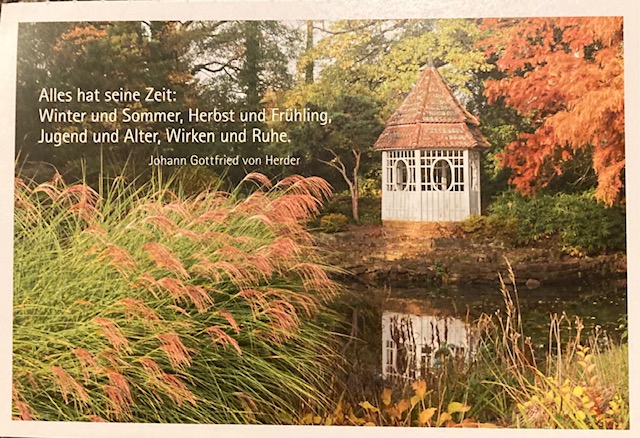
Everything Has Its Time

 The title of this blogpost is the first four words of a quotation by the 18th century German philosopher, theologian and poet, Johann Gottfried Herder. In full, it reads, "Everything has its time: winter and summer, autumn and spring, youth and old age, work and rest."


Reading his words reminded me of the famous lines in the third chapter of the Book of Ecclesiastes, often used in funerals:

"For everything there is a season, a time for every matter under the sun;
A time to be born, and a time to die; a time to plant, and a time to uproot;
A time to break down, and a time to build up; a time to weep, and a time to laugh;
A time to mourn, and a time to dance; a time to speak, and a time to keep silent;
For everything there is a season, and a time for every matter under the sun."

I have come to believe deeply in the idea that everything has its time. It is, perhaps, most clearly in evidence in the natural world: Summer follows Spring, then Autumn, then Winter, then Spring again. And each season has its own beauty, it's own "feel".  I have found beauty and wonder in Salcey Forest in all seasons. 

Yesterday, my husband and I finally got round to visiting Westonbirt Arboretum in Gloucestershire and the Autumn foliage was absolutely glorious to see.... every shade of yellow, orange, brown, red and burgundy you could imagine - no photo does justice to it.


We have decided to return in the Spring, when the trees will be in blossom - a treat to look forward to.

But as the quotation by Herder said, it is not only natural beauty and the cycle of the seasons which has its time - the whole of our lives are a process of change and growth and eventually of dying back. And each season of our lives has its own beauty, its own wonder - the wide-eyed innocence and enthusiasm of the child; the teenage years, during which we think we know it all; the settling in to career and our place in society, which makes up the rest of the first half of life and so on.

It is the second half of life in which we commonly yearn for something other than earthly goals - a sense of longing can possess our souls, turning us towards the spiritual, towards the divine. This second-half of life pilgrimage does not have an end point - we travel on, deeper into the heart of God, letting go of the things which seemed so important in our earlier years - status, belongings, and so on.

The autumn of one's life can be rich and fulfilling, if we can allow ourselves to continue to grow, while simultaneously letting go, slowing down. It's a fine balance to find, but can lead to true contentment and a secure sense of being where we need to be. For example, last week, I met my great-nephew for the first time, which was so special. Even if I don't feel "old enough" to be a great aunt!

"For everything there is a season, and a time for every matter under the sun."

Friday, 22 October 2021

Reaching New Shores

 The 19th century German poet, Friedrich Rückert wrote, "It is only possible to reach new shores by meeting other people."


And I absolutely agree with him, in so far as we learn most of what we know, most of what influences us, most of what is useful to us, from other people. If we never came under the influence of the thoughts and wisdom of others, it would be far harder for us grow, to become the best people we can be.

I have certainly had my mind and spirit opened and expanded by interactions with many Unitarians, particularly at Summer School and when I have the (now rare) chance to receive worship, rather than leading it. And have been supported on my Unitarian journey by many friends and colleagues.

But I do not think it is necessary to actually *meet* other people face to face in order to learn from them, to reach new shores because of them. I have never met many of the people who have had deep and strong influences on my life, face to face. One of these is my first spiritual director, a UUA minister whom I only met via Skype. But she had a huge influence on my life and on my spiritual growth.

I have also been greatly influenced in my journeys as a Unitarian and as a writer, by the authors of the books I love. Richard Rohr, John O'Donohue, Rainer Maria Rilke, Hafiz, the authors of Quaker Advices and Queries on my Unitarian journey, and J.R.R. Tolkien, Brandon Sanderson, David Eddings, Anne Lamott, Liz Gilbert and Stephen King on my writing journey. 

It is also possible to be influenced by marvellous quotes on Facebook feeds, by podcasts and by speakers on YouTube. If we are willing to be open to new ideas, the possibilities of learning, of reaching new shores through our learning, are endless.

I have never met any of the authors I have mentioned above, yet their words have influenced me profoundly. I believe that one of the greatest gifts we can give ourselves is to be open to the wisdom of others. 

Who has enabled you to reach new shores?


Friday, 15 October 2021

The Splendour of Gardens

 The 18th century "woman of letters" (as Wikipedia describes her), Madame de Staël, once wrote, "The splendour of gardens has the love of nature as a prerequisite."


This quotation instantly reminded me of the words by Dorothy Frances Gurney, the English hymn writer and poet, which my grandfather wrote in my autograph book when I was a little girl:

"The kiss of the sun for pardon,
The song of the birds for mirth - 
One is nearer God's heart in a garden
Than anywhere else on earth."

He was a great gardener, my grandfather. Just after World War II, he and my grandmother moved into a huge Victorian house in Woolton, having never seen inside it, on the strength of loving the gardens. I blogged about their adventure here.

Sadly, I have never been a gardener myself. I love admiring other people's gardens, enjoy visiting the beautiful gardens and grounds of stately homes, and watch Gardener's World every week. But I find actual gardening rather too much like hard work.

But I do have the love of nature the quotation by Madame de Staël speaks of. Nothing lifts my heart, restores my soul, so quickly as being out in the natural world, whether that is up in the mountains, by the sea or in my beloved Salcey Forest. There is something wonderful - wonder-full in the true sense of that word - about nature. Its astonishing complexity, its simple beauty - these nourish the deepest parts of me and I have often written about it in this blog. There is something about being away from people, being surrounded by the glories of nature that brings me back into balance, with myself, with the Divine.

And that is a blessing.


Friday, 8 October 2021

Off the Beaten Track

 The 19th century German novelist, Theodor Fontane, once wrote, "But all the best things, like everywhere in life, lie off the beaten track."


I'm not sure about this one... Some of the best things in my life have been directly on the main path of my journey - my marriage, my children, my first career as a librarian. All these were things I consciously headed towards and enjoy(ed) when they happened.

But if he means that life can give us some delightful surprises when we aren't expecting them, then yes, I agree. And often, so it seems, things which later become important in our lives, we stumble across by accident. To give just one example, if my young daughter hadn't contracted conjunctivitis and if I hadn't taken her up to our local shopping centre in the pushchair to get us both out of the house, I might never have seen the advert in the estate agent's window for the home we have lived in for the past 23 years. And it was the best move we ever made.

Spiritual insights can also turn up in our lives when we aren't expecting them. I've written about my revelation that God is love in the centre of everything here. That insight changed my life big time. And on many occasions, my spiritual director or someone at Summer School has said something to me that has opened doors in my soul. These have added immeasurably to the richness of my spiritual life and I am grateful.


Friday, 1 October 2021

Patience, Strength and Perseverance

Patience, strength and perseverance are not the first three qualities I think about when someone mentions the word "love." But according to Kristina, the 17th century Queen of Sweden, "These are the three blessed virtues that are found in true love: patience, strength, perseverance."


Although I suppose they may be three qualities which are required to have unconditional love for someone. Because all of us have faults, all of us have shortcomings, all of us will disappoint those who love us at some point in our lives. 

So we will need patience in our true love for our beloved, patience when they don't do what we think they should, patience when what they do or say disappoints us, patience when they are in a bad place and unable to respond to us. And also patience with ourselves, so that we are prepared to sit alongside them without expectation.

We will need strength in our true love for our beloved, because a weak love is not true love. We need to be strong and convicted in our love for the beloved. And also strong to hold them up, or to pick them up when they fall.

We will need perseverance in our true love for our beloved, because *every* relationship (whether it is between spouses, siblings or parents & children) goes through bad patches (one time I'm not afraid to generalise!). We need to hang on to our love for our beloved to see us through these bad patches. And we need to persevere in our love, and not give up when things aren't good. (Which is not to say that we should stay in an abusive relationship - far from it. Just that when we feel a little bit meh, we should hang on to our love for the beloved.)

And I find it consoling to remember that God's love for us is patient, strong and persevering.

What three qualities do you think are the "three blessed virtues that are found in true love"?