“I am only one, but still I am one.
I cannot do everything, but still I can do something.
And because I cannot do everything,
I will not refuse to do the something I can do.”

Edward Everett Hale

Saturday, 25 May 2019

A Travelling Companion

This week's photo is of three wheeled huts, parked on a beach. The text, by Margaret Lee Runbeck, says, "Glück ist keine Station, bei der man ankommt, sondern eine Art zu reisen."


Which being translated, means "Happiness is not a station to arrive at, but a way to travel."

The American Declaration of Independence speaks of "life, liberty and the pursuit of happiness" as "certain unalienable rights" with which all of humankind is endowed. I agree that all humankind has the right to life and the right to liberty, but I'm not so sure about "the pursuit of happiness".

Because I believe that happiness should not be not the goal of our lives, but a way of being in the world, which makes our journey through life easier. I think that pursuing happiness might actually lead to not being happy, where we are at the present moment. If we fall into the "if only" trap, we can actually be postponing the possibility of happiness.

For example, "I'll be happy, if only I could lose ten pounds." "I'll be happy, if I get a promotion at work." "I'll be happy, if only ... [fill in the blanks yourself]".

The knack is to find ways of being happy where we are, right now. Stanley A. Mellor, Unitarian minister at Hope Street Church in Liverpool during World War One, delivered a series of addresses which were published under the title The Last Victory: Studies in Religious Optimism. I was given this book as a gift a few years ago, and it touched me profoundly.

Mellor explains: "Their purpose was... to remind people again of the conditions under which glowing faith must always furnish its warmth in a finite world, to face certain fundamental perplexities in the light of faith, and to provide encouragement and hope. The responsibility of surviving into the world of peace after war... must press heavily on every sensitive spirit, and the need for radiant constructive faith in the ultimate goodness and worth of life is very great, and will become greater."

The whole book is a paean of hope, of "radiant constructive faith in the ultimate goodness and worth of life." I have blogged about it here and would like to repeat one further quote from that post:

"The part of The Last Victory which has brought the most enlightenment is where Mellors insists that 'Optimism is not a scientific certainty, no true optimist ever said it was. It is an affirmation of the spirit, a risk accepted by the soul... Call it what you will, belief in the unseen world, belief in the reality of the Ideal, faith in the solidarity and eternal value of goodness... the certainty remains that without it Humanity cannot go forward, and without we ourselves can do no good and worthy work in the world.'

Happiness is a way to travel, not a distant goal to be pursued.


Friday, 17 May 2019

Living in the Moment


This week's quote is by Friedrich Schiller, "Nicht in die ferne Zeit verliere dich! Den Augenblick ergreife, der ist dein." Which being translated, means, "Do not lose yourself in the distant time! Take the moment, that's yours."


Over the past few years, I have come to believe that God’s presence is everywhere, in our ordinary, everyday lives, if we had but eyes to see, and ears to hear. I believe that through sacred living - weaving moments of attention into our everyday lives, and recognising the sacred there, we will find that which gives our lives purpose and meaning. Sacred living is about living with a new level of awareness. It is about going through each normal day paying attention to what is happening in each passing moment. It is about noticing the presence of the divine, the numinous, everywhere, in the natural world, in other people, in ourselves, and in things that happen to us. Then, as Mary Jean Irion wrote, “Normal day, let me be aware of the treasure you are. Let me learn from you, love you, savour you, before you depart. Let me not pass you by in quest of some rare and perfect tomorrow.”

Because today is all we have. Today is the only place in which time touches eternity. I love the Sanskrit affirmation: “Look to this day - For it is life, the very life of life. In its brief course lie all the verities and realities of your existence: the bliss of growth, the glory of action, the splendour of beauty. For yesterday is but a dream, and tomorrow is only a vision, but today well lived makes every yesterday a dream of happiness and every tomorrow a vision of hope. Look well, therefore, to this day.”

Yet how often do we spend our days (or one day or even part of a day) totally present? Appreciating every moment, every interaction, every person or object or things our senses come into contact with? I know I don’t!

So how do we spend our days? Many of us, especially as we grow older, spend them living in the past, looking back with either pleasure or regret (or a mixture of both). And there’s absolutely nothing wrong with being nostalgic about our past lives, so long as the past is a place we visit, rather than the place we live. As the Sanskrit wise one said: “yesterday is but a dream.” It is no longer real.

Others of us spend our days in the future, always heading towards the next goal, the next hill to climb. Our diaries are full for weeks to come, and there always seems to be a long to-do list on the go. I write a new one, every Monday morning, to make sure that all the things I need to get done in the forthcoming week, somehow get done. And yes, forward planning is important, as we try to juggle home life, work life, looking after children, looking after parents, some sort of social life. If we didn’t plan, everything would fall down crash.

There is a beautiful prayer, quoted by Rachel Naomi Remen, in her book, My Grandfather's Blessings, which sums all this up, much more beautifully than I can:

“Days pass, and the years vanish and we walk sightless among miracles.

Lord, fill our eyes with seeing, and our minds with knowing.
Let there be moments when your Presence,
like lightning, illumines the darkness in which we walk.
Help us to see, wherever we gaze,
that the bush burns, unconsumed.
And we, clay touched by God,
will reach out for holiness, and exclaim in wonder:
‘How filled with awe is this place, and we did not know it.’”
Amen

Friday, 10 May 2019

Running out of mojo

This week's quotation is by Johann Wolfgang von Goethe: "Aller Anfang ist leicht, und die letzten Stufen werden am schwersten und seltesten erstiegen."


Which being translated, means, "The beginning is easy and the final stages are the most difficult and rarest to climb (reach)."

Jury's out on this one, for me. Yes, I agree that we often start new projects with great enthusiasm, and then, once we get down into the nitty gritty and hard grind, our enthusiasm can peter out and we have to call on all our reserves to finish the job properly. It takes great determination and dedication to do this, as I have blogged before here.

BUT, sometimes beginning something is the hardest step - not easy at all. Especially if we believe that the task ahead of us is going to be difficult, or complicated. It is only too easy to put off beginning, to do other things to distract ourselves from what we ought to be getting on with.

I'm usually quite good at getting things done, but creative writing is the one exception to this rule. Faced with a blank page, is is only too tempting to fool around on Facebook, or on Wikipedia, or make another coffee, go for a walk, even do some housework!... almost anything except get some words down onto that terrifying blankness.

And then, if we do manage to make a start on the task, it is easy (but fatal) to listen to the voices of self-doubt in our heads. "This is no good." "You can't do this." "X is so much better / cleverer / more artistic than I am - what's the point of even trying?"

We have to get over this self-doubt by telling ourselves: "I'm doing this. It may not be the best [whatever] in the world, but it's my task, and I'm going to finish it, because it has to be done."

Where do you fall? Do you find beginnings easy and completions hard, like Goethe? Or are beginnings the hardest thing of all?

Saturday, 4 May 2019

The power of dreams

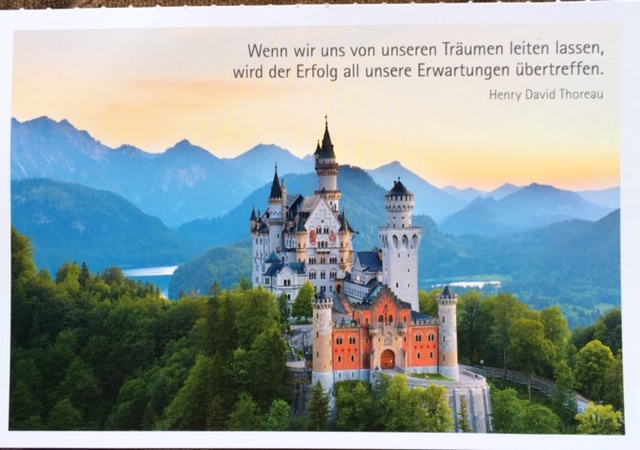
This week's quotation is by Transcendentalist Henry David Thoreau, above a beautiful photo of Neuschwanstein Castle. It reads "Wenn wir von unseren Träumen leiten lassen, wird der Erfolg all unsere Erwartungen übertreffen."

Which being translated, means: "If we let our dreams guide us, success will surpass all our expectations."


I have a dream.

At the 2015 General Assembly meetings, all ldelegates were given a 48-page document entitled Vision for Our Future produced by the Executive Committee, which also went out to all congregations. It was followed by another, entitled The Next Steps.

In the Vision for Our Future document, there were a series of headings, the first of which read, "We want to be a faith that matters." Well, our faith does matter - it matters enormously, both to current Unitarians, and to potential Unitarians, who are out there, desperately seeking somewhere they can call home, somewhere they can find like-hearted (not necessarily like-minded) folk to accompany them on their own spiritual / religious journeys.

BUT, unless those seekers (and current Unitarians) clearly understand who we are and what we're about, we aren't going to attract new people through our doors.

We Unitarians have always been so hot and strong about being the "faith without a creed" and about the pre-eminence of freedom of belief. And that is right and good. BUT I'm afraid it is now becoming a disadvantage in some ways, as only too often we find it difficult to articulate our faith, except in negative terms. For example, there was a photo of a particular congregation's noticeboard on Facebook a while back - five sheets of paper with statements that started "We don't".

We need to find easy-to-articulate, POSITIVE answers to "What do Unitarians believe?" and "What are Unitarians?" Which is why I carried out my survey in 2017, which resulted in the book Unitarians: Together in Diversity. Which is chock-full of positive statements about what Unitarians believe, and how we come together in community.

But I have come to believe that the statement the Executive Committee made in Vision for Our Future, about needing to "re-establish an identity, a unique spiritual position" is key to our future as a denomination, as a movement. As James Barry so acutely pointed out in his contribution, "We don't have the advantage of the UUA, who have their seven principles defined."

I believe that the most vital task for British Unitarians today is to adopt a widely agreed statement such as the UUA's Seven Principles (or why not just adopt them wholesale? - they work for me!). I believe that one of the main reasons why the Quakers are so much more successful than we are, is that other people understand what they believe in and stand for.

We could even produce our own versions of Advices and Queries, the Quaker touchstones, and of Quaker Faith and Practice, their comprehensive book about Quaker beliefs and practices. Why not?


Sunday, 28 April 2019

The core of life

What is the core of life?

This week's quotation is by Oscar Wilde. Unfortunately, I have been unable to find an English version of it, to compare with the translation. And my German is not wonderful. And I'm not sure I agree with the Google translator. So I offer you two versions of this German phrase: "Im Wachstum liegt des Denkens und des Lebens Kern."


Which Google thinks, means, "Growth is the thinking and the life of the core."
I think it may mean. "In growth lies the core of thought and life."

Either way, I think it's saying that without thinking deeply and living wholeheartedly, we will not grow as people. It is so easy to skate along the surface of our lives, not going deep, being involved purely with exterior matters. But going deep hurts. It means facing those parts of ourselves which we have hidden for years, maybe decades, and coming to terms with what we find there. It is the only way to grow, spiritually.

And it's about letting go of the need for the approval, the approbation of others. When we go deep, when we live from the core of our lives, we will find the courage to stand up for what we believe, rather than going along with what others believe, for the sake of fitting in. And living from our core also means letting go of comparing ourselves with others, because we, just as we are, are enough.

It's also about compassion, about walking a mile in the other person's shoes, realising that they, too, have a unique, precious life at their core. Deep may talk to deep, seeing past the shallow façades we present to the world. Allowing our vulnerabilities to show, because that is the truest way to live. Living from our hearts, not our heads.

Karen Armstrong writes, in The Spiral Staircase, "The one and only test of a valid religious idea, doctrinal statement, spiritual experience, or devotional practice was that it must lead directly to practical compassion. If your understanding of the divine made you kinder, more empathetic, and impelled you to express this sympathy in concrete acts of loving-kindness, this was good theology. But if your notion of God made you unkind, belligerent, cruel, or self-righteous, or if it led you to kill in God's name, it was bad theology."

Compassion enables us to grow spiritually, to live our lives from our cores.

Monday, 22 April 2019

Taking a New Path

Last week's quotation (which I haven't blogged about until today, because the photo took 48 hours to make its way from my mobile phone to my computer!) is by Charles de Foucauld. In translation, it reads, "There is not a moment in our lives, in which we cannot take a new path."


Which I guess I agree with in principle. However, in practice, we are often prone to missing the new path at our feet, and plodding along the same, well-worn track, however poorly it is serving us. Because it takes courage to make a change in our lives, and the ego part of our brains much prefers the status quo. And we also have to be awake, aware of the new path opening in front of our feet.

In my own case, there has to be a definite nudge, a definite call, to take a new path.  And being a bookish type, it has often come in the form of something I have read, from whole books to single sentences, which have jumped off the page and hit me in the face. Or the wise words of a friend or colleague.

For example, my decision to take the path of quitting drinking, five and half years ago, was the result of an unfortunate incident, when I got drunk and incoherent in front of people I respected, and my spiritual director's injunction to "sit with the shame and see where that takes you." I gave up drinking a few weeks later, and have not had a drink since.

The decision to take a new path is often not an easy one. But it is always, always worthwhile, so long as we have thought it through and don't do it on a whim. I believe that our hearts and wills have to be pulling in the same direction as our heads, in order for a new path to be successful. We have to deeply desire to take the new path, not just feel we "ought" to. Ought to, in my experience, rarely works.

For example, I have lost count of the number of times that I have said to myself "I really ought to lose ten pounds." But my will has not been working in harness with my mind, so I have stuck to the diet for a few weeks, and then given up. Because I've not had the nudge, not really desired, with all of me, to lose that weight. My Personal Trainer at the gym wants me to lose a few pounds, but I'm finally happy with my body as she is (after years of self-loathing and beating myself up) - all my clothes fit me, and at 59, I have come to accept a few lumps and bumps as part of growing older. I work out to be healthy and strong, not to lose weight... and, I love chocolate so much! The idea of depriving myself to lose that ten pounds is not an attractive one, so I don't.

What new path may be opening in front of you?

Sunday, 21 April 2019

Peace in Community

I've just spent four wonderful days at the Annual Meetings of the General Assembly of Unitarian and Free Christian Churches - one day at the Ministers' Pre-conference, and the other three at the Annual Meetings.


photo by Rory Castle-Jones

As usual, it was wonderful to catch up with friends, many of whom I have not seen since last GA (as the Annual Meetings are affectionately known).

The Ministers' Pre-conference included a gorgeous session about Metta meditation, led by Maud Robinson, which included a twenty-minute practice of this loving-kindness meditation. In retrospect, it set the scene for the whole GA, at least for me.

The AGM of the Unitarian Peace Fellowship was on the first afternoon of the Meeting proper. The Peace Fellowship was founded in 1916, the depths of World War I, and for the last few years, the theme of the gathering following the AGM has been connected to the centenary commemorations of this bloody, futile war.

But this year, 2019, our theme was "Where do we go next?" Nearly a hundred people turned up (twice as many as normal), and the discussion that followed was rich and fascinating. The hunger for peace, for Unitarians to be involved in social action related to peace, was palpable in the room.

Then later, it was time for Peace Vespers, led by the current ministry students. Again, the turn-out was greater than usual, and it was a gentle, peaceful end to the first day of the Meetings.

The following morning, I attended the morning meditation led by Richard Bober of the Meditation Fellowship, which grounded me for the busy day ahead.

In the evening, the Anniversary service was conducted by Maria Curtis and Andy Phillips, on the theme Knowing Our Place - an impassioned plea for humankind to take care of our world and each other.

On the final morning, the motion on knife crime was passed - more evidence of our desire for peace in our communities. At the end of the session, our Peace Fellowship Treasurer, Celia Cartwright, was inducted as President of the General Assembly.

I came home on Thursday afternoon feeling comforted and strengthened for the year ahead. I had experienced peace in our beloved community.