“I am only one, but still I am one.
I cannot do everything, but still I can do something.
And because I cannot do everything,
I will not refuse to do the something I can do.”

Edward Everett Hale

Friday, 18 June 2021

Aim Small and Build

 This week's quotation is attributed to "Chinese wisdom". It reads, "It is better to do small deeds, than to plan great ones." 


I think the implication here is that we often get overwhelmed by great deeds and give up part way through. 

But I believe that the biggest and greatest deed can be completed, so long as we break them down into smaller parts and patiently complete each smaller part, one at a time.

In her wonderful book for writers, Bird by Bird, Anne Lamott includes a chapter on short assignments, because she knows how overwhelming the prospect of writing a whole book can be. She writes, "I finally notice the one-inch picture frame that I put on my desk to remind me of short assignments. It reminds me that all I have to do is to write down as much as I can see through a one-inch picture frame. This is all I have to bite off for the time being."

She further quotes E.L Doctorow, who wrote, "Writing a novel is like driving a car at night. You can see only as far as your headlights, but you can make the whole trip that way."

I find the words of both Lamott and Doctorow inspirational. It means that we don't have to panic about completing a big task (like writing a dissertation or a novel or whole service, or cleaning the entire house from top to bottom) but need only tackle the small task at hand.

I try to write for an hour each morning. Some days I breeze through it, the ideas floating up in my mind, eager to be transcribed onto the computer. But far more often, I sit and gaze at the blank page on my laptop and have absolutely no clue what to write. Then I think of Anne Lamott's words and get down a small picture frame I have above my desk (see below) and remind myself that I only have to write one scene, or even part of a scene. And that it won't be perfect, but that doesn't matter. The important thing is to write something, anything. Because that can then be revised and edited.


Even Mount Everest was climbed one step at a time...


Friday, 11 June 2021

Self-help or Grace?

 This week's quotation is by that inimitable apologist for atheism, Richard Dawkins. He writes, "Our life is as meaningful, as full and as great as we make it ourselves."


And I do agree with him, up to a point. Our attitude to life, to the events, people, places and things we encounter is very much up to us. Some of us are glass half-full people, who look on the bright side, others are glass half-empty people, who see the problems and pain in everything they encounter. Then there are the realists, who insist that they see life exactly as it is. 

BUT, for those of us who are religious and/or spiritual, there is another dimension to life, which for simplicity's sake, I will call grace. Christians have many ideas as to what "grace" means, but for me, it is a free gift from God, which has the power to transform us, on the soul level. 

I love liberal Catholic theologian Richard Rohr's take on the meaning of grace. He believes (and I do too) that God's love is limitless and unconditional - we don't have to earn it; we just have to accept it. Grace is how God works in the world to wake us up and enable us to accept His/Her love. I believe that it is through God's freely-given grace that we are able to live full and great and meaningful lives.

In her wonderful book, My Grandfather's Blessings, Rachel Naomi Remen shares a beautiful prayer, which for me, epitomises the difference between relying on ourselves, as Richard Dawkins advises and accepting the gift of God's love: 

"Days pass, and the years vanish and we walk sightless among miracles.
Lord, fill our eyes with seeing and our minds with knowing.
Let there be moments when your Presence, like lightning, illumines the darkness in which we walk.
Help us to see, wherever we gaze, that the bush burns, unconsumed.
And we, clay touched by God, will reach out for holiness and exclaim in wonder:
'How filled with awe is this place, and we did not know it.'"

Amen.


Friday, 4 June 2021

Seeing Our Reflection

 William Makepeace Thackeray, author of the 1848 novel, Vanity Fair, once wrote, "The world is a looking glass and gives back to every man the reflection of his own face."


I think that what he meant by this is that what we see depends on how we look at the world. And that how we act may influence how the world responds to us. It's the old "glass half full or glass half empty" effect.

I'm not saying that the world is a wonderful, perfect place (although parts of it surely are), nor that we should ignore all the bad things happening to our neighbour (in the broadest sense of that term). On the contrary, when we see living beings in distress, it is our duty to reach out and do what we can. 

Each of us is a complex human being, whose life has been shaped by all our experiences leading up to this moment. And I believe that how we have responded to these experiences in the past will dictate how we respond to them now, how we will respond to them in the future. Of course, bad things happen to all of us, and it takes a good deal of resilience to bounce back from these, rather than being broken by them.

But I believe that our underlying attitude to life does have an effect on how well (or poorly) we respond to events in our lives and in the wider world. If we look at the world to see the best in it, then that is what we will see. If we focus on the unpleasant, sad, bad, that is what we will see. If we see the world as a harsh place and ourselves as victims, it will be more difficult for us to discern the beauty and good all around us.


Because there always *is* some beauty and good around us, no matter how harsh our circumstances. Victor Frankl, the Austrian Holocaust survivor, shared some precious wisdom about this:

"Everything can be taken from a man but one thing: the last of the human freedoms - to choose one's attitdue in any given set of circumstances, to choose one's own way."

"When we are no longer able to change a situation, we are challenged to change ourselves."

"Between stimuls and response there is a space. In that space is our power to choose our response. In our response lies our growth and our freedom."

"Between stimulus and response there is a space. In that space is our power to choose our response." How we see the world, how we see ourselves, will depend on the response we choose.


Friday, 28 May 2021

One Step at a Time

 Martin Luther King Jr once wrote, "Faith is taking the first step, even when you can't see the whole staircase."


Yes. We have to learn to trust in ourselves, in what is important to us, and take that first step anyway. I believe that faith and trust are facets of our nature which we are born with. But as life goes on, and we encounter betrayal in our lives, that faith and trust can be eroded. It can take a lifetime to choose to be sufficiently vulnerable enough to dare to trust again.

And these betrayals, which sadly seem to be an inevitable part of life, need not be great ones which bring our whole world crashing down around us.  Any time someone lies to us, even a white lie, or doesn't turn up when they said they would, or is unkind to us, we can feel betrayed. Once we feel that way, it can take a lot of time to build up sufficient faith to make the world seem trustable again. 

In her book Daring Greatly: How the Courage to be Vulnerable Transforms the Way We Live, Love, Parent and Lead, BrenĂ© Brown explains that, "it's a chicken-or-the-egg issue: We need to feel trust to be vulnerable and we need to be vulnerable in order to trust. There is no trust test, no scoring system, no green light that tells us that it's safe to let ourselves be seen. The research participants described trust as a slow-building, layered process that happens over time."

So it is wonderful to see people like Martin Luther King Jr, who have faith in what they believe, have faith in what they are working towards, and take that first step anyway, regardless of the consequences. It takes courage to have faith, courage to trust, courage to be vulnerable. But if we choose to live with faith and trust, the rewards can be wonderful, wonder-ful.


Friday, 21 May 2021

Happiness is Where You Find It

I thoroughly agree with David Dunn's view that, "Happiness has to be found along the way, not at the end of the road."


Because if we always have our eyes fixed on the end of the road, on a fictional happiness that will happen in the future, if only we do X, Y or Z, it is very easy for us to miss out on the ordinary, everyday instances of happiness happening right under our noses.

As human beings, we live in time, so it is natural to look towards the future, and there is nothing wrong with that. So long as it doesn't mean that we ignore what is happening to us right now. I've just spent three glorious days with my best friend in Cumbria, and thoroughly enjoyed every last minute of it. Yes, I had been looking forward to it for weeks, but I also enjoyed it as it was happening. It was glorious weather on Wednesday and we enjoyed a brisk walk along Roanhead Beach and then visited Furness Abbey.


An extra thrill was provided by our GA President, Anne Mills, who had kindly dropped off the Vice-Presidential medallion at Celia's house for me. So we had a small presentation ceremony, which has made it all seem real, in a way which the Zoom occasion did not.


Happiness can indeed be found along the way...


Friday, 14 May 2021

The Efficacy of Flowers

 I love this week's quotation, by Chao Hsiu Chen, "When a flower blooms, it shows us its beauty. If it does not bloom, it teaches us hope."


Flowers show us their beauty and lift our hearts. I walk either in the fields around the village or in Salcey Forest most days and my heart is always lifted by the sight of a flower I have never seen before - snowdrops, primroses, daffodils, tulips and just now, bluebells. I mark the passing of the days and of the seasons by the flowers that bloom.


And I suppose that a flower that does not bloom does teach us hope, in that we can wait in patience for it to bloom. 

But I have more often been taught hope by flowers that bloom in the oddest places - in the cracks of pavements, for example. They seem to prove that no matter what their environment, they will still burst forth in their glory. And that we can do the same, no matter how harsh our own situation.

They can also teach us about the power of nature to overcome man-made environments. I can remember seeing a photo of Chernobyl, the Russian city which had the nuclear incident in 1986. Nature has taken it over now...


I think that flowers can be a potent symbol of hope. They hold out the promise that there will always be new life, even in the darkest times.

What brings you hope, as we come out of this pandemic?


Friday, 7 May 2021

A Few Clouds in the Sky

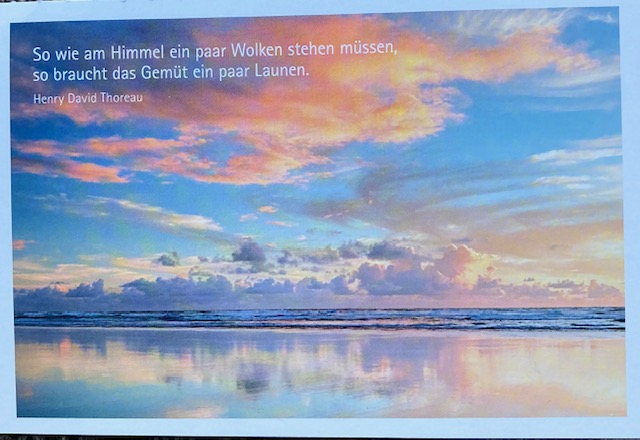
 Henry David Thoreau, the 19th century Transcendentalist, wrote, "Just as there must be a few clouds in the sky, so the mind needs a few moods."


Blue sky days are lovely and I very much enjoy walking in the forest on such days, like this morning, when the trees are silhouetted against the rich, glorious blue. 


Yet I know that without the rain we've had for the past few days, the forest would not be as green and lush as it is. So yes, the clouds (and the rain) are needed.

So much for the first half of Thoreau's words. I guess by "the mind needs a few moods", he means that we can't be happy all the time. Or if we are, we're probably ignoring something in our own lives, or in the world around us. For example, many folk are nostalgic for the past, which their memory has edited into an ideal golden age, where everything went right. If I think back to my own childhood summers, the sun was always shining and I was playing outside happily with my friends. Yet I know objectively that rain often "stopped play" and we were driven inside. And that my childhood, like most people's, was not a time of undiluted happiness.

It is only when we go deep, and see the clouds, that we can understand ourselves fully. Doing the necessary shadow work can be very painful, but it is necessary, if we are to be whole. I have blogged about this here. Life isn't all sunshine and rainbows, and it is by learning from the clouds, from the sad or painful things which happen to us, that we grow.

Let us embrace all our moods, which have something to teach us, if we are patient enough to sit and observe them, rather than rushing into action to make ourselves happy again.