“I am only one, but still I am one.
I cannot do everything, but still I can do something.
And because I cannot do everything,
I will not refuse to do the something I can do.”

Edward Everett Hale

Friday, 4 June 2021

Seeing Our Reflection

 William Makepeace Thackeray, author of the 1848 novel, Vanity Fair, once wrote, "The world is a looking glass and gives back to every man the reflection of his own face."


I think that what he meant by this is that what we see depends on how we look at the world. And that how we act may influence how the world responds to us. It's the old "glass half full or glass half empty" effect.

I'm not saying that the world is a wonderful, perfect place (although parts of it surely are), nor that we should ignore all the bad things happening to our neighbour (in the broadest sense of that term). On the contrary, when we see living beings in distress, it is our duty to reach out and do what we can. 

Each of us is a complex human being, whose life has been shaped by all our experiences leading up to this moment. And I believe that how we have responded to these experiences in the past will dictate how we respond to them now, how we will respond to them in the future. Of course, bad things happen to all of us, and it takes a good deal of resilience to bounce back from these, rather than being broken by them.

But I believe that our underlying attitude to life does have an effect on how well (or poorly) we respond to events in our lives and in the wider world. If we look at the world to see the best in it, then that is what we will see. If we focus on the unpleasant, sad, bad, that is what we will see. If we see the world as a harsh place and ourselves as victims, it will be more difficult for us to discern the beauty and good all around us.


Because there always *is* some beauty and good around us, no matter how harsh our circumstances. Victor Frankl, the Austrian Holocaust survivor, shared some precious wisdom about this:

"Everything can be taken from a man but one thing: the last of the human freedoms - to choose one's attitdue in any given set of circumstances, to choose one's own way."

"When we are no longer able to change a situation, we are challenged to change ourselves."

"Between stimuls and response there is a space. In that space is our power to choose our response. In our response lies our growth and our freedom."

"Between stimulus and response there is a space. In that space is our power to choose our response." How we see the world, how we see ourselves, will depend on the response we choose.


Friday, 28 May 2021

One Step at a Time

 Martin Luther King Jr once wrote, "Faith is taking the first step, even when you can't see the whole staircase."


Yes. We have to learn to trust in ourselves, in what is important to us, and take that first step anyway. I believe that faith and trust are facets of our nature which we are born with. But as life goes on, and we encounter betrayal in our lives, that faith and trust can be eroded. It can take a lifetime to choose to be sufficiently vulnerable enough to dare to trust again.

And these betrayals, which sadly seem to be an inevitable part of life, need not be great ones which bring our whole world crashing down around us.  Any time someone lies to us, even a white lie, or doesn't turn up when they said they would, or is unkind to us, we can feel betrayed. Once we feel that way, it can take a lot of time to build up sufficient faith to make the world seem trustable again. 

In her book Daring Greatly: How the Courage to be Vulnerable Transforms the Way We Live, Love, Parent and Lead, Brené Brown explains that, "it's a chicken-or-the-egg issue: We need to feel trust to be vulnerable and we need to be vulnerable in order to trust. There is no trust test, no scoring system, no green light that tells us that it's safe to let ourselves be seen. The research participants described trust as a slow-building, layered process that happens over time."

So it is wonderful to see people like Martin Luther King Jr, who have faith in what they believe, have faith in what they are working towards, and take that first step anyway, regardless of the consequences. It takes courage to have faith, courage to trust, courage to be vulnerable. But if we choose to live with faith and trust, the rewards can be wonderful, wonder-ful.


Friday, 21 May 2021

Happiness is Where You Find It

I thoroughly agree with David Dunn's view that, "Happiness has to be found along the way, not at the end of the road."


Because if we always have our eyes fixed on the end of the road, on a fictional happiness that will happen in the future, if only we do X, Y or Z, it is very easy for us to miss out on the ordinary, everyday instances of happiness happening right under our noses.

As human beings, we live in time, so it is natural to look towards the future, and there is nothing wrong with that. So long as it doesn't mean that we ignore what is happening to us right now. I've just spent three glorious days with my best friend in Cumbria, and thoroughly enjoyed every last minute of it. Yes, I had been looking forward to it for weeks, but I also enjoyed it as it was happening. It was glorious weather on Wednesday and we enjoyed a brisk walk along Roanhead Beach and then visited Furness Abbey.


An extra thrill was provided by our GA President, Anne Mills, who had kindly dropped off the Vice-Presidential medallion at Celia's house for me. So we had a small presentation ceremony, which has made it all seem real, in a way which the Zoom occasion did not.


Happiness can indeed be found along the way...


Friday, 14 May 2021

The Efficacy of Flowers

 I love this week's quotation, by Chao Hsiu Chen, "When a flower blooms, it shows us its beauty. If it does not bloom, it teaches us hope."


Flowers show us their beauty and lift our hearts. I walk either in the fields around the village or in Salcey Forest most days and my heart is always lifted by the sight of a flower I have never seen before - snowdrops, primroses, daffodils, tulips and just now, bluebells. I mark the passing of the days and of the seasons by the flowers that bloom.


And I suppose that a flower that does not bloom does teach us hope, in that we can wait in patience for it to bloom. 

But I have more often been taught hope by flowers that bloom in the oddest places - in the cracks of pavements, for example. They seem to prove that no matter what their environment, they will still burst forth in their glory. And that we can do the same, no matter how harsh our own situation.

They can also teach us about the power of nature to overcome man-made environments. I can remember seeing a photo of Chernobyl, the Russian city which had the nuclear incident in 1986. Nature has taken it over now...


I think that flowers can be a potent symbol of hope. They hold out the promise that there will always be new life, even in the darkest times.

What brings you hope, as we come out of this pandemic?


Friday, 7 May 2021

A Few Clouds in the Sky

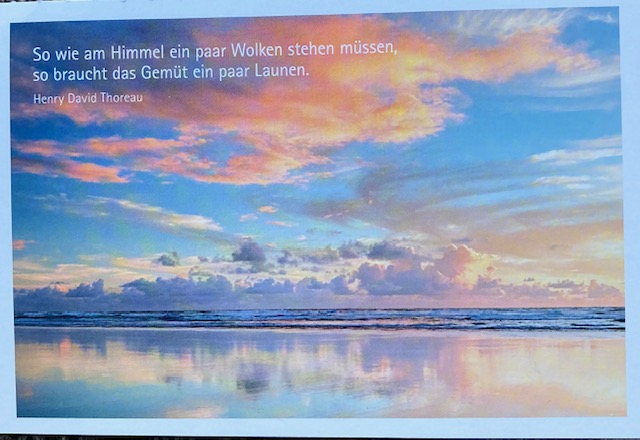
 Henry David Thoreau, the 19th century Transcendentalist, wrote, "Just as there must be a few clouds in the sky, so the mind needs a few moods."


Blue sky days are lovely and I very much enjoy walking in the forest on such days, like this morning, when the trees are silhouetted against the rich, glorious blue. 


Yet I know that without the rain we've had for the past few days, the forest would not be as green and lush as it is. So yes, the clouds (and the rain) are needed.

So much for the first half of Thoreau's words. I guess by "the mind needs a few moods", he means that we can't be happy all the time. Or if we are, we're probably ignoring something in our own lives, or in the world around us. For example, many folk are nostalgic for the past, which their memory has edited into an ideal golden age, where everything went right. If I think back to my own childhood summers, the sun was always shining and I was playing outside happily with my friends. Yet I know objectively that rain often "stopped play" and we were driven inside. And that my childhood, like most people's, was not a time of undiluted happiness.

It is only when we go deep, and see the clouds, that we can understand ourselves fully. Doing the necessary shadow work can be very painful, but it is necessary, if we are to be whole. I have blogged about this here. Life isn't all sunshine and rainbows, and it is by learning from the clouds, from the sad or painful things which happen to us, that we grow.

Let us embrace all our moods, which have something to teach us, if we are patient enough to sit and observe them, rather than rushing into action to make ourselves happy again.

Friday, 30 April 2021

Walking Our Own Paths

 I have to admit that I find this week's quotation, by French writer, Antoine de Saint-Exupéry, confusing. It reads, "Do not just walk the smooth roads. Walk paths that no-one has walked before, so that you leave traces and not just dust."


Because no-one walks exactly the same path as anyone else - we are all unique human beings, coming from unique parentage, backgrounds and past experiences, all of which will impact our choice of the roads we travel throughout our lives. 

I suppose it might mean that we should try to choose the path that makes the most sense to us, at the deepest level of our being and at the point of our decision, rather than blindly following the choices or decisions of others. We might call this the way of integrity, perhaps. For most people, it is so much easier to follow the "smooth roads", so much harder to strike out on our own, because it requires more bravery, more confidence in our own choices. Especially if by doing so, we are going against the opinions of others, of the silent majority. 

It is a deep human instinct to take our problems to someone else, someone we think is wiser than we are, stronger than we are, and allow them to influence our paths, even to make our decisions for us. But in the end, if we want to grow into the best people we can be, only we should, only we can, make our decisions, our choices, for ourselves. Because, as I said, each person is unique, so what is right for one may not be right for another.

Many of the choices we make will have little impact on the lives of others, or even on our own lives. But sometimes, they will change our lives, setting us on a new course, which we could not have imagined before we made that choice, set our feet on that path. When I was doing German A level, many years ago, one of our set texts for the literature element was Sansibar oder der letzte Grund by Alfred Andersch. It was about exactly this - a small group of people in the little north German town of Rerik during World War II, who make decisions which will change their lives. As Walter G. Hesse writes in his introduction to it, "The people in this tense tale seem very ordinary and familiar at the outset, yet they are drawn into a web of nightmarish incidents which force all of them to decisions which raise them far above the ordinary and familiar." He calls them "the few... to whom moral values were more important than safety."

Hesse continues, "Everyone who doubts, who retains a measure of questioning intellect or belief, even if he is not as capable as those who can 'read the signs', will eventually, by talk or action, undermine an authority which can maintain itself only through the silence of the passive majority... Everyone who contradicts the money-lenders and traders in this contemporary temple is... forced to renounce selfish interests."

The symbol of this "measure of questioning intellect or belief" is a little wooden statue, called Der Lesende Klosterschuler or the reading monk, which one of the characters, a pastor named Helander, asks the fisherman, Knudsen, to smuggle out of the country, because within the privacy of his own head, the reading monk is free, and this is a symbol the Nazis cannot bear. It is a wonderful book, which had a great impact on me.


Der lesende Klosterschuler (photo in book, Rembrandt-Verlag, Berlin)

So we need to take thought at every choice point, and try to discern what the right thing, the moral thing is, for us, at that particular instant in our journey through life. We should not be afraid to do the right thing, even if it is different. We should be willing to follow the still, small voice of our consciences, or that of the Divine spark within, and blaze our own trail, thus leaving traces of our path for others to be inspired by.


Friday, 23 April 2021

Beauty through Joy

 French philosopher and mystic, Simone Weil, wrote, "Through joy the beauty of the world penetrates our soul." 


And yes, I agree with her. But I'm not sure about the order in which it happens. I can go for a walk in Salcey Forest feeling quite anxious about something, and it is the beauty of the forest which penetrates my soul, and then the joy happens.

Yet I guess it is also true that when we are feeling joyful, it is easier for us to perceive the beauty of the world. For example, the way my heart lifts when I turn right off the A623 towards Foolow, and know that the Nightingale Centre is only a matter of minutes away. A sensation which I guess will be well known to many Unitarians from the South and the Midlands.


John O'Donohue has a beautiful blessing, For Beauty:

As stillness in stone to silence is wed,
May solitude foster your truth in word.
As a river flows in ideal sequence,
May your soul reveal where time is presence.
As the moon absolves the dark of distance,
May your style of thought bridge the difference.
As the breath of light awakens colour,
May the dawn anoint your eyes with wonder.
As spring rain softens the earth with surprise,
May your winter places be kissed by light.
As the ocean dreams to the joy of dance,
May the grace of change bring you elegance.
As clay anchors a tree in light and wind,
May your outer life grow from peace within.
As twilight pervades the belief of night,
May beauty sleep lightly within your heart.

As I transcribed his beautiful words, my heart was filled with joy. Amen, amen.